
Gastroenterology: Why the right entry must not be a matter of luck
Gastroenterology is a target specialty for many doctors because the field is clinically dense, technically demanding, and clearly positioned within internal medicine. At the same time, one thing applies: in gastroenterology, what decides is not the job listing, but the system behind it. Duty structures, endoscopy reality, supervision, rotations, outpatient clinics and team organisation determine whether a start becomes sustainable development. docMeds brings order to this decision before you commit.
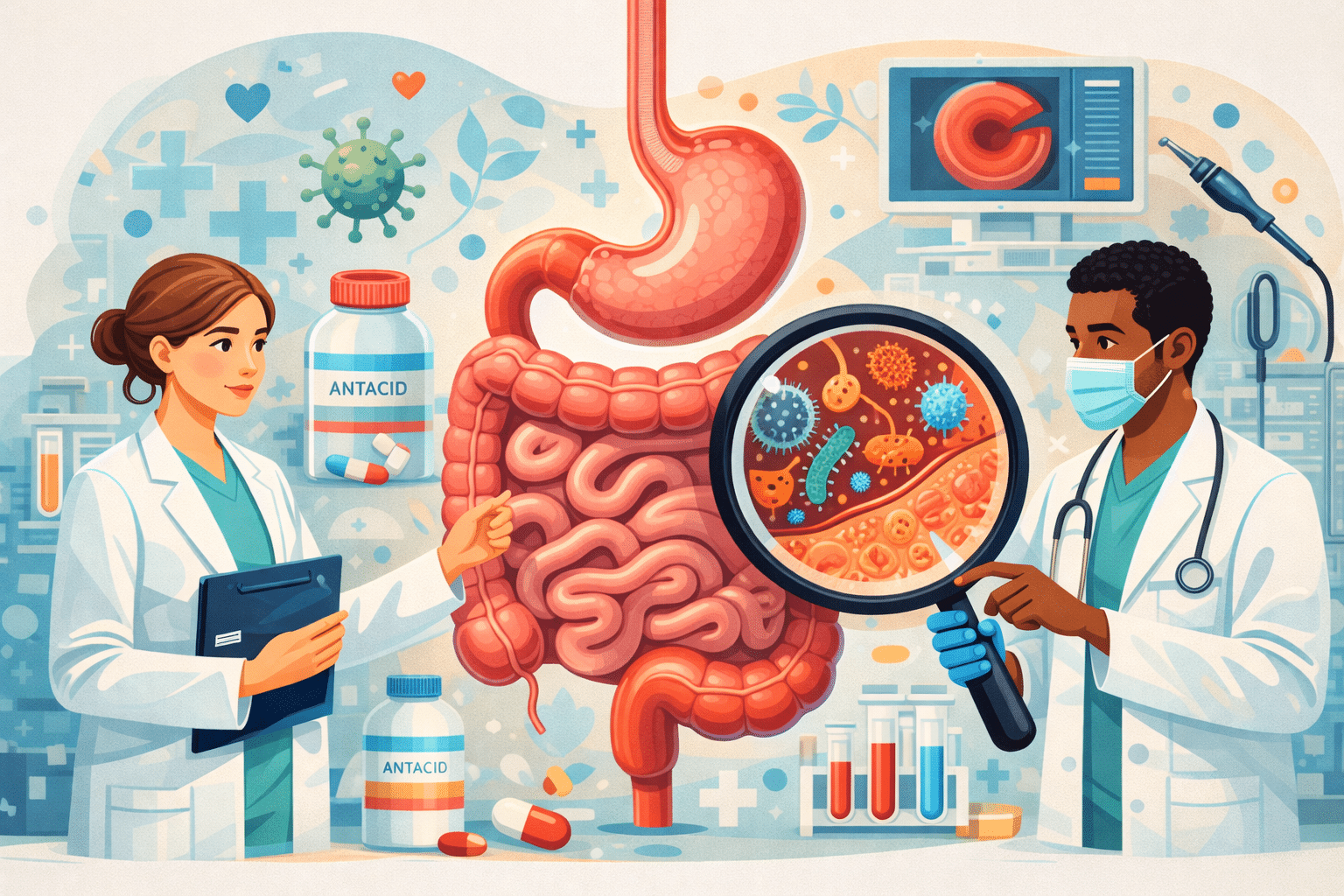
You do not want to start “somewhere” in gastroenterology — you want to start safely?
docMeds assesses your situation: career direction, profile, timeline and the reality of hospital structures. So an open option in gastroenterology becomes a sustainable decision — and you do not have to correct later what could have been clarified beforehand.
Role & responsibility: what gastroenterology really demands
Gastroenterology is rarely “just” a subspecialty. In many hospitals it is a hub: emergency medicine, intensive care, oncology, surgery, radiology, infectious diseases and general medicine feed into the same patient pathways. Anyone entering the field works in a specialty that is both broadly internal and technically precise. This breadth can build substance. But it can also wear you down if the system does not support you.
What matters is not individual tasks. It is system logic: how responsibility is distributed, how stable supervision is, how clear decision pathways are, how endoscopy is organised, and how pressure is handled when diagnostics and therapy run in parallel. In gastroenterology, you do not feel this “later” — you feel it immediately. docMeds exists to assess this reality upfront, rather than regret it afterwards.
Many think of careers in terms of CVs and titles. In clinical reality, something else matters: sustainability. Sustainability means you can maintain performance over time without burning out internally. That is what determines whether you grow in gastroenterology — or merely endure. docMeds starts here: not with wishful thinking, but with real conditions.
Why the market is misleading: demand is not a quality marker
The job market often feels comfortable: there are responses, interviews, quick offers. In gastroenterology this is not unusual, because many hospitals have demand. And that is exactly where the trap lies: demand is mistaken for quality. A vacant post initially only says someone is needed — not that the setting will support you.
Demand arises for different reasons. Sometimes from growth, sometimes from friction. Friction does not mean “bad” in a moral sense, but structurally: high turnover, supervision that is too thin, unclear duty structures, lack of predictability, endoscopy overload. For you, what matters is whether you enter a system that builds you up, or a system that primarily sees you as a gap filler. docMeds helps you recognise these differences early.
Many careers are slowed not by lack of competence, but by the wrong framework. If you work long-term with too little support, learning becomes a side effect. Training does not become “bad”, but it becomes blurred. docMeds ensures that in gastroenterology you do not invest months into uncertainty, but into development.
Why the setting matters: structure beats motivation
Motivation matters. But motivation does not stabilise an unstable system. In gastroenterology, the same person can grow in one hospital and mentally exit within a few months in another — with identical effort. The difference is the setting: team logic, leadership, duty system, predictability, communication culture and the real organisation of endoscopy.
Leadership & support
Good leadership makes decisions easier. Poor leadership pushes pressure downwards. In gastroenterology, you feel this daily: prioritisation, escalation routes, boundaries of responsibility.
Supervision
Supervision is a safety structure. Without supervision, responsibility is not learned — it is endured. docMeds looks for real availability, not phrasing in interviews.
Duty structures
Duty structures determine rest, concentration and the ability to learn. If duty structures are chronically chaotic, your daily life is externally controlled.
Endoscopy reality
Endoscopy is not a “nice extra” — it is core. What matters is whether you learn predictably or merely function at high tempo without a real development line.
docMeds does not evaluate these fields in the abstract, but in relation to your profile: experience, career direction, time window and your desired development. So in gastroenterology you do not enter “just anywhere”, but into a setting that supports you long-term.
What matters day to day: sustainability rather than buzzwords
In gastroenterology, quality rarely shows in polished wording. It shows in how the day runs: handovers, priorities, documentation, consults, endoscopy scheduling, ward rhythm and coordination with other specialties. If systems are stable, a rhythm emerges. Rhythm protects: it reduces errors, reduces friction and makes learning possible.
If systems are unstable, constant improvisation appears. Constant improvisation is not a “thrill”, but a slow drain of energy. That is why assessment matters. docMeds ensures you recognise this dynamic upfront, rather than only feeling it after weeks.
The point is not that work must be “easy”. The point is that it must be sustainable. Sustainable means you can keep performance stable without consuming yourself internally. docMeds helps you set this sustainability as the benchmark — before you sign.
Training & specialist pathway: why development needs structure
Many start in gastroenterology with a clear aim: specialist training, endoscopy competence, sub-specialisation. In practice, however, training does not simply “run alongside”. It depends on rotations, real time windows, supervision and how the hospital prioritises training. If daily work constantly runs on the edge, training becomes a side effect.
That does not mean you will not learn. You will learn. But the question is: do you learn predictably? Or do you learn mainly through friction? Predictability exists where structure exists. Structure is decision security: you know where you stand. docMeds ensures you do not accept training as a promise, but assess it as a sustainable line.
Particularly in gastroenterology, breadth is an advantage — if it is guided. Without guidance, breadth becomes pressure: many topics, many fronts, little depth. docMeds helps you choose a position where breadth becomes strength — not overload.
If you want clarity, do not start with assumptions. Start with assessment: 👉 https://docmeds.de/beratung/ or directly via 👉 https://docmeds.de/kontakt/
Why offers collapse: relief is not a quality marker
Offers often arise from a feeling: pressure drops, uncertainty ends, “finally things move forward”. That is human. But in gastroenterology this dynamic is risky, because relief says nothing about sustainability. Sustainability shows in day-to-day reality: under time pressure, on calls, in conflicts, in handovers, in prioritisation.
If conditions are unclear, mood often changes quickly: initial euphoria, then persistent fatigue, then internal withdrawal. Not because you “cannot cope”, but because the system does not support you. docMeds prevents this spiral by assessing options upfront — not repairing afterwards.
In gastroenterology, stability is particularly important because patient complexity is high. Complexity needs calm. Calm does not come from less work, but from clear structures. docMeds helps you avoid an environment where complexity and chaos land on you at the same time.
Why detours are costly: time, energy, career mobility
A false start rarely looks dramatic. It looks quiet. You lose weeks, you lose focus, you lose learning energy. The biggest price is often not a single on-call shift, but the creeping feeling: “I am only ever catching up.” In gastroenterology, time is a critical factor, because development is strongly tied to continuity.
Many try to replace uncertainty with activity: more applications, more interviews, more options. That feels like control, but is often just movement without direction. docMeds reduces this friction: less scatter, better fit, more decision security. So you do not invest months only to realise the conditions do not support you.
FAQ
Short answers to common questions.
Official orientation (external resources)
For reliable fundamentals, use reputable sources such as the German Medical Association (Bundesärztekammer), the Federal Ministry of Health and the Federal Employment Agency. These sources help with broad orientation — the decision in gastroenterology is assessed sustainably with docMeds.
docMeds: so your entry supports you — not just starts
docMeds brings your goal, profile and clinical reality into a clear line — so entry into gastroenterology is not a matter of luck, but becomes predictable. You get structure, clarity and guidance: fewer detours, less risk, more stability.
What we do
- Assessment of your situation & goals
- A focused strategy instead of scatter
- Fit instead of chance
- Guidance through to a decision
- Clear communication, clear next steps
Contact (direct)
Conclusion: understood — now decide safely
In gastroenterology, positions are available — but the right decision is created through sustainability. If you do not want to guess, but choose stably: docMeds makes the process clear, predictable and safe.

